Friday, October 28, 2011
blog background tutorial
The Airports Authority's actions ignited a public preservation effort that culminated in 1992 with legislation that the Virginia General Assembly enacted and that Governor L. Douglas Wilder approved. The legislation required the Airports Authority to "take all steps necessary to insure the preservation in place, the study, and the interpretation to the public" of the Abingdon ruins during a one year period that followed the law's enactment. During that period, James Wilding, the general manager of the Airports Authority, reported to the Authority's planning committee that multiple options had been identified that would provide adequate parking without having to excavate the Abingdon site.
In 1864, the Federal government of the United States confiscated Abingdon and the nearby "Arlington Plantation" after the owners of each property failed to pay their taxes in person. (A tenant had offered to pay Abingdon's taxes on behalf of the property owner (Bushrod Hunter). However, the government's tax collector refused to accept the payment.) The government then sold the Abingdon property to Lucius E. Chittenden, Register of the Treasury in the Abraham Lincoln administration. Chittenden then leased the property to Henry M. Bennett.
Two years later, in 1989, the Airports Authority revealed that it was planning to replace the Abingdon ruins with a new parking garage. To comply with the provisions of Section 106 of the National Historic Preservation Act of 1966, the Authority commissioned a series of studies that described the history of Abingdon and the archaeological features of the Abingdon site and its surroundings. The final report of the series, issued in 1991, summarized the studies and examined several alternative treatments of the site. The report stated:
According to one account, John Parke Custis served on George Washington's staff during the Siege of Boston in 1775-1776 and became an emissary to the British forces there. He befriended a young British officer on the staff of General William Howe, 5th Viscount Howe. While in Cambridge, Massachusetts, the officer gave Custis a weeping willow (Salix babylonica) twig that the officer had taken from a famous tree that Alexander Pope had planted at Twickenham and that was first of its kind in England. The officer had intended to plant his willow sprig wrapped in oiled silk along a stream on land he would seize from the Americans. However, following his army's defeat, he decided to give the sprig to Custis. Custis then planted the twig at Abingdon. The resulting tree reportedly became the parent of all of the weeping willows in the United States at the time of the account (1881).
The Romans consumed rabbit
Book: Fictional rabbits
Domestic rabbits can be kept as pets in a back yard hutch or indoors in a cage or house trained to have free roam. Rabbits kept indoors are often referred to as house rabbits. House rabbits typically have an indoor pen or cage and a rabbit-safe place to run and exercise, such as an exercise pen, living room or family room. Rabbits can be trained to use a litter box and some can learn to come when called. Domestic rabbits that do not live indoors can also serve as companions for their owners, typically living in a protected hutch outdoors. Some pet rabbits live in outside hutches during the day for the benefit of fresh air and natural daylight and are brought inside at night.
Rabbits graze heavily and rapidly for roughly the first half hour of a grazing period (usually in the late afternoon), followed by about half an hour of more selective feeding. In this time, the rabbit will also excrete many hard fecal pellets, being waste pellets that will not be reingested. If the environment is relatively non-threatening, the rabbit will remain outdoors for many hours, grazing at intervals. While out of the burrow, the rabbit will occasionally reingest its soft, partially digested pellets; this is rarely observed, since the pellets are reingested as they are produced. Reingestion is most common within the burrow between 8 o'clock in the morning and 5 o'clock in the evening, being carried out intermittently within that period.
Bear hunting · Big game hunting · Deer hunting · Waterfowl hunting · Wolf hunting · Upland hunting
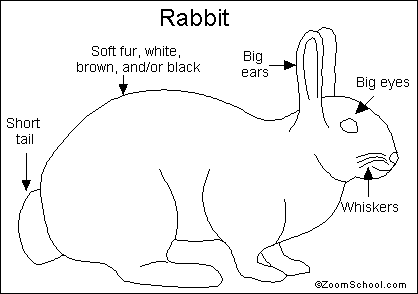
Because the rabbit's epiglottis is engaged over the soft palate except when swallowing, the rabbit is an obligate nasal breather. Rabbits have two sets of incisor teeth, one behind the other. This way they can be distinguished from rodents, with which they are often confused. Carl Linnaeus originally grouped rabbits and rodents under the class Glires; later, they were separated as the predominant opinion was that many of their similarities were a result of convergent evolution. However, recent DNA analysis and the discovery of a common ancestor has supported the view that they share a common lineage, and thus rabbits and rodents are now often referred to together as members of the superclass Glires.
Domestic rabbits can be kept as pets in a back yard hutch or indoors in a cage or house trained to have free roam. Rabbits kept indoors are often referred to as house rabbits. House rabbits typically have an indoor pen or cage and a rabbit-safe place to run and exercise, such as an exercise pen, living room or family room. Rabbits can be trained to use a litter box and some can learn to come when called. Domestic rabbits that do not live indoors can also serve as companions for their owners, typically living in a protected hutch outdoors. Some pet rabbits live in outside hutches during the day for the benefit of fresh air and natural daylight and are brought inside at night.
Rabbits graze heavily and rapidly for roughly the first half hour of a grazing period (usually in the late afternoon), followed by about half an hour of more selective feeding. In this time, the rabbit will also excrete many hard fecal pellets, being waste pellets that will not be reingested. If the environment is relatively non-threatening, the rabbit will remain outdoors for many hours, grazing at intervals. While out of the burrow, the rabbit will occasionally reingest its soft, partially digested pellets; this is rarely observed, since the pellets are reingested as they are produced. Reingestion is most common within the burrow between 8 o'clock in the morning and 5 o'clock in the evening, being carried out intermittently within that period.
Bear hunting · Big game hunting · Deer hunting · Waterfowl hunting · Wolf hunting · Upland hunting
Because the rabbit's epiglottis is engaged over the soft palate except when swallowing, the rabbit is an obligate nasal breather. Rabbits have two sets of incisor teeth, one behind the other. This way they can be distinguished from rodents, with which they are often confused. Carl Linnaeus originally grouped rabbits and rodents under the class Glires; later, they were separated as the predominant opinion was that many of their similarities were a result of convergent evolution. However, recent DNA analysis and the discovery of a common ancestor has supported the view that they share a common lineage, and thus rabbits and rodents are now often referred to together as members of the superclass Glires.
Thursday, October 27, 2011
Labels Ghost Pictures
The next morning, the Sheriff and Coroner discover a strange mold around the dead Professor’s throat – a sign they both know to mean that the Mummy stalks Mapleton again. The Sheriff questions Amina, who is dazed, but Tom Hervey arrives and tries to provide an alibi for her. Elwood finally dismisses the pair and Tom takes her home.
In Egypt, in the year 1974, Yousef Bey journeys to a remote temple in answer to a summons from Andoheb, High Priest of Arkan. Andoheb has called him to undertake a mission for the priesthood, but first refreshes his memory on the story of Kharis. The same story is being told to a group of skeptical college students in Mapleton, Massachusetts. Professor Norman expands on the story, explaining how Kharis was kept alive by the fluid of the leaves of the Tana bush, a plant that has long been extinct. In fact, Professor Norman himself was entrusted with a quantity of the tana leaves that investigators found in order to conduct scientific research.
Back in Egypt, Andoheb informs Yousef Bey that Kharis still lives and that Yousef’s mission is to retrieve Kharis and the body of Ananka and return them to their rightful resting place in Egypt. Yousef Bey then pledges his devotion.
The mummy Kharis was destroyed in fires in the previous two Universal films, only to reappear in the next with no explanation for how it survived. This appears to be a recurring theme through Universal monster movies, with little to no explanation given for the return of dead characters.
The Mummy's Ghost is the 1944 Universal Pictures sequel to The Mummy's Tomb. Lon Chaney, Jr. again takes on the role of Kharis the mummy.
In Egypt, in the year 1974, Yousef Bey journeys to a remote temple in answer to a summons from Andoheb, High Priest of Arkan. Andoheb has called him to undertake a mission for the priesthood, but first refreshes his memory on the story of Kharis. The same story is being told to a group of skeptical college students in Mapleton, Massachusetts. Professor Norman expands on the story, explaining how Kharis was kept alive by the fluid of the leaves of the Tana bush, a plant that has long been extinct. In fact, Professor Norman himself was entrusted with a quantity of the tana leaves that investigators found in order to conduct scientific research.
Back in Egypt, Andoheb informs Yousef Bey that Kharis still lives and that Yousef’s mission is to retrieve Kharis and the body of Ananka and return them to their rightful resting place in Egypt. Yousef Bey then pledges his devotion.
The mummy Kharis was destroyed in fires in the previous two Universal films, only to reappear in the next with no explanation for how it survived. This appears to be a recurring theme through Universal monster movies, with little to no explanation given for the return of dead characters.
The Mummy's Ghost is the 1944 Universal Pictures sequel to The Mummy's Tomb. Lon Chaney, Jr. again takes on the role of Kharis the mummy.
Subscribe to:
Posts (Atom)